For the last three years, most teams have treated AI like a subscription:
Send a prompt to ChatGPT, Claude, or another closed model
Connect to MCPs, to access a knowledge base
Get an answer back, and move faster.
That works for occasional, ad-hoc tasks — and we can say this workflow is just fine. But it starts to break down when the work depends on private data, internal workflows, high volume, regulated information, location intelligence, and domain-specific decisions.
The core issue is control. If your company’s data, workflows, customer context, and operating strategy are what make the business valuable, then the AI layer that reasons over that information should not live entirely inside someone else’s platform and be used to train public models. Do you want your internal database to train the next version of Claude Opus?
Businesses use these public, closed-source AI providers (the "AI Giants") because they are convenient. A team can buy a subscription, open an app, send a request, and get a useful answer in seconds. They're pre-trained on information from the public domain. For general work, that makes sense. For critical workflows, this convenience comes with rapidly rising costs as more and more tokens are consumed, even if cost per token falls. Users also have less control over how the model behaves, how usage is governed, and where private company data really goes.
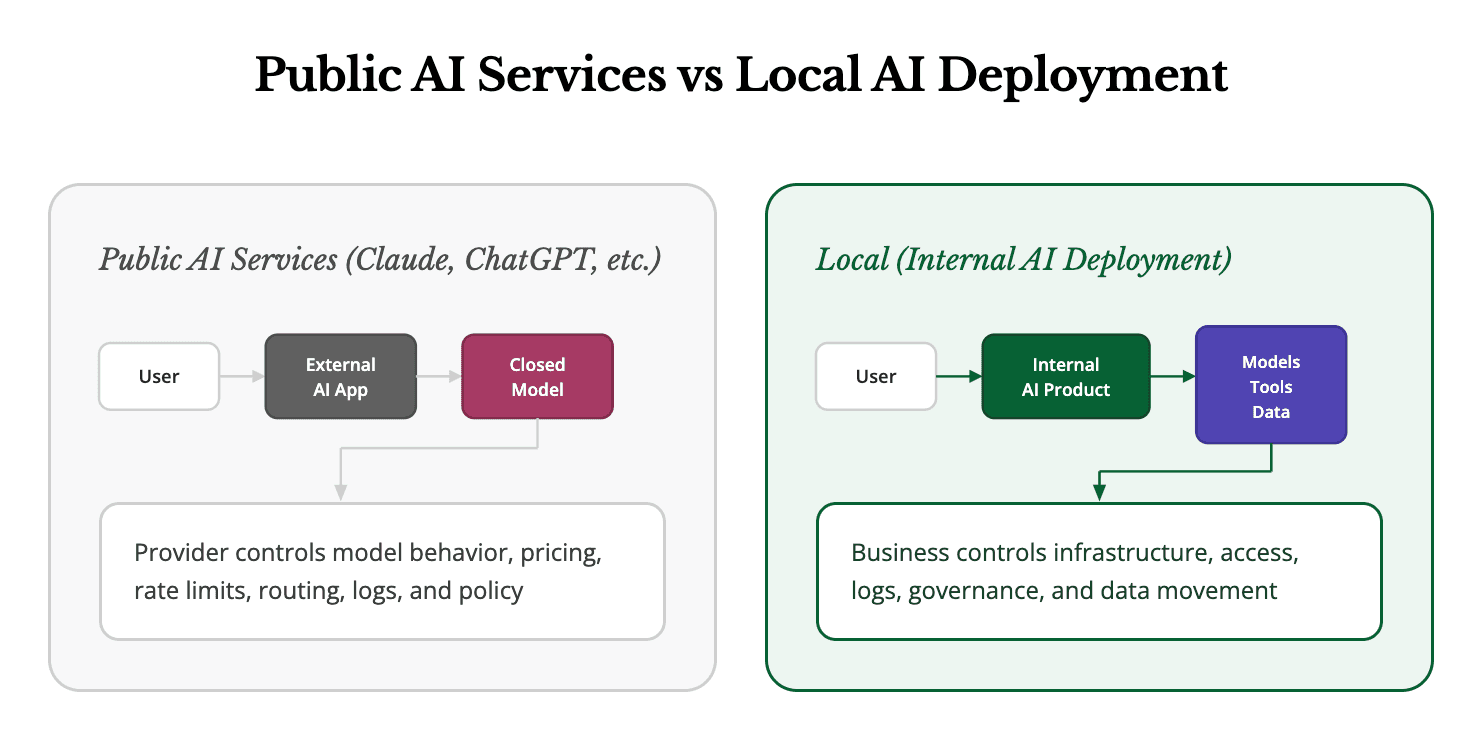
Open-source models deployed on your company's own infrastructure change that tradeoff. They let your business build its own AI layer on owned or controlled systems. Access can be governed. Sensitive data can stay private. Compliance and audit trail requirements can be designed into the workflow. Usage can be logged, reviewed, and flagged when something looks risky or malicious. And token costs are drastically reduced as you only pay for compute cost.
That is the kind of AI layer Locate Alpha is building for real estate businesses.
Open source over closed models, why?
1. Closed-source models can pull the rug
Closed-source AI models are models where the provider controls the model weights, hosting, inference stack, product interface, API behavior, pricing, and update cycle. ChatGPT, Claude, Gemini, and many managed AI APIs operate this way. They are easy to use because the business does not need to host anything, tune anything, or maintain infrastructure. A user can open the app, make a request, and get an answer.
This convenience puts the business at the mercy of decisions made entirely by the provider.
A closed-source provider can change:
Rate limits: the number of requests your team can make per minute, hour, or day can change.
Pricing: API pricing can increase with short notice, which affects workflows already built around the model.
Model behavior: the model can be updated, aligned differently, or "nerfed" without your team approving the change.
Routing: requests can be routed to a smaller, cheaper, or different model tier without the user clearly noticing.
Context limits: the amount of data the model can process in one request can change.
Product features: tools, plugins, browsing, file uploads, memory, or API features can be modified or removed.
Data policies: how prompts, outputs, logs, and user data are handled can change based on provider policy.
Access: accounts, regions, workloads, or use cases can be restricted by the provider.
For ad-hoc tasks, this is usually acceptable. If someone is drafting a one-off email, summarizing a public article, or brainstorming copy, changes in model behavior, pricing, or limits won't have a big impact on your business.
However, decision pipelines are different. Daily workflows are different. If a business depends on AI to evaluate assets, summarize lease risk, classify maintenance issues, support underwriting, analyze portfolios, or generate operational reports, then model instability becomes business instability. A small upstream change causes the output to look different, slowing down your teams, breaking automations, increasing token consumption, and weakening the governance across the workflows people rely on every day. Your local open-source model will change only when you want it to.
Open-source does not mean falling behind. New models and improvements are released regularly, and a well-designed AI system keeps the model separate from the company’s data, tools, governance, and workflows. This allows newer models to be evaluated against real business tasks and adopted without rebuilding the entire system. Newer updates/enhanced models can be pushed to the end user after the model has been rigorously tested with the business workflow or the product.
2. Not every task needs a frontier model
"You don't need a Ferrari to cross the street"
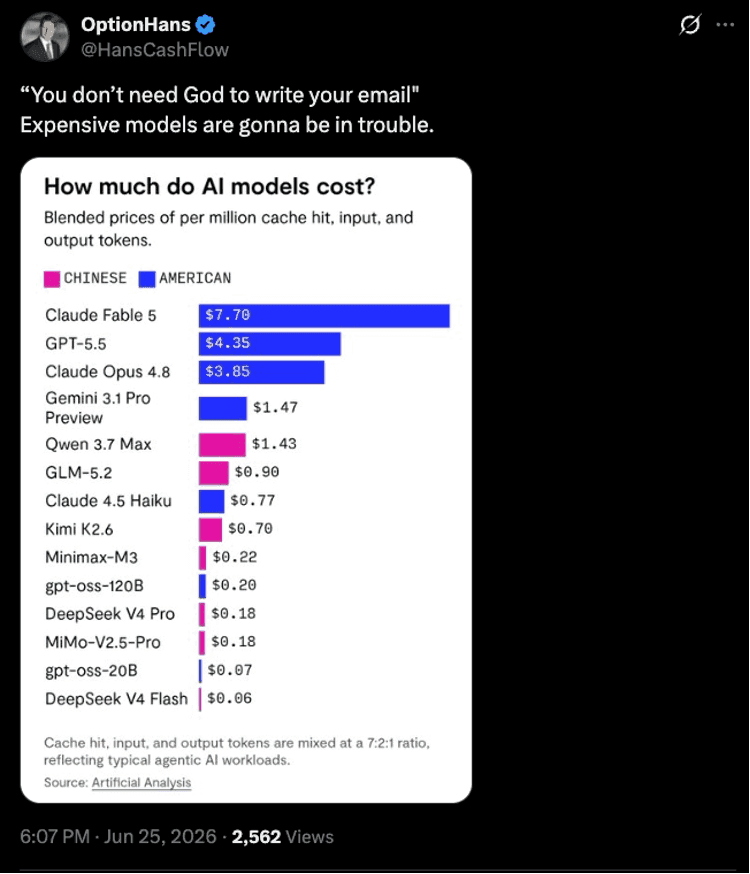
Use the right model for the right task. The market often treats the frontier model as the default choice:
If the model is more powerful, use it for everything
If the benchmark score is higher, route every task through it
If the model is frontier-class, make it the default operating layer
Frontier models are valuable when the task actually needs frontier-level capability:
Complex reasoning: multi-step analysis, ambiguous tradeoffs, hard technical synthesis, or non-obvious planning.
Long-horizon tasks: work that needs to hold context across 50+ steps, documents, tools, or decisions.
Multi-system orchestration: Frontier models excel at orchestrating extremely complex workflows with many moving parts, but for most business processes—including those in real estate—well-managed open-source models are fully sufficient and offer more control and predictability.
Most business workflows need these capabilities:
Privacy: sensitive data should not move through more systems than necessary.
Consistency: the same task should produce stable, reproducible, predictable, auditable output.
Speed: routine workflows should not wait on the largest available model.
Cost governance: token expenditure should be measurable, controlled, and routed based on task value.
This is where open-source models matter. Modern open models come in many sizes, and size is usually described by parameter count. A parameter is a learned number inside the model. When someone says a model is 3B, 8B, or 24B, they mean roughly 3 billion, 8 billion, or 24 billion learned parameters. Bigger models can be more capable, but they are also usually slower and more expensive to run.
Examples:
Phi-4 Mini from Microsoft: a 3.8B parameter model with a 128K context window.
Qwen3 from Alibaba: an open model family ranging from very small models like 0.6B and 1.7B up to 32B.
Mistral Small from Mistral AI: a 24B parameter model designed to balance capability, latency, and cost.
These models are not all trying to replace frontier models. They are useful because many business tasks do not need a frontier model in the first place.
3. Private business data needs private infrastructure
A prompt is not always harmless text. In business workflows, a prompt can contain leases, addresses, rent rolls, customer records, asset locations, financial assumptions, internal strategy, source code, or contract clauses.
For real estate companies, the risk is higher. Location data can reveal:
Where your assets are
Which markets you are entering
Which properties are under review
Where the company may expand next
Which competitors or customers are strategically important
Your users may not know whether they are using a consumer product, business product, enterprise plan, API, or third-party wrapper. They may not know what is logged, retained, reviewed, routed, or used to improve future systems.
When models run on trusted infrastructure, your company gets to define the rules:
What data is sent
Where it is processed
Who can access it
How long logs are stored
What gets redacted
What usage should be flagged
Why Locate Alpha can build this
1. We train your model
Behind Locate Alpha's platform sits our Canadian R&D Center — a partnership with a leading Toronto polytechnic college that pioneers research that goes into Locate Alpha's products.
If you have a rich history of proprietary data — repair records and costs, transaction histories, asset performance, operational logs — we can train a private model that learns from it and turns it into a competitive advantage. We handle the heavy lifting of building, tuning, and benchmarking the model, then our product team packages it into something your team can actually use day to day.
This work receives annual support from the Natural Sciences and Engineering Research Council of Canada (NSERC) Applied Research and Development Grant. Critically, you retain full ownership of the resulting intellectual property. It's a rare combination: the AI research depth of a larger organization, paired with the real estate domain expertise that ensures the models we build actually solve the problems that matter in your business.
2. AI empowers your asset management function
Asset management is the work of understanding how properties, leases, rent, maintenance, tenants, location, and portfolio performance connect to business outcomes. Teams use that information to decide where attention is needed, which assets are performing, where risk is building, and what actions should happen next.
The questions asset managers ask are practical and focused—like tracking which properties or leases need attention, understanding performance, and monitoring costs across their portfolio. The value comes from helping them quickly pinpoint issues and guide decisions based on what matters day to day.
To make AI useful here, the system has to understand the data, the terminology, the workflow, and the expected output. A generic chatbot can answer around the problem. A product built around the workflow can help the team move through the problem.
3. Our external data greatly enhances your model
Your internal data tells you what's happening inside your portfolio — but the forces that move your returns happen outside your walls. That's where external data becomes essential. We already compile mountains of it so you don't have to: rental comps closing in the area, new supply coming online, shifting school scores, and dozens of other signals that shape value and demand. Fed alongside your own records, this external context sharpens every prediction your model makes — turning a system that only knows your history into one that understands the market moving around it.
4. We give your application a data layer AI understands
Most companies already have useful data spread across warehouses, CRMs, property-management systems, spreadsheets, internal tools, and reporting databases. The problem is that the AI model does not automatically know which data exists, what it means, or which source should be trusted. Without that context, AI tries, and often fails, to make sense of the data on the fly. To make AI more intelligent, we deploy a "metadata of metadata" platform to handle this.

We incorporate your company's data into a catalog. It helps the system understand what data exists, what each dataset is used for, where it came from, and which source should be trusted for a business question.
Your analyst does not need to know the ins and outs of the data warehouse. They do not need to remember table names, column names, or where a report came from. The data always resides in your own enterprise data warehouse and integrates seamlessly with Locate Alpha's external market data. Your analyst asks a business question, and the system finds the right context before it answers.
5. We orchestrate your real estate workflow with deep domain knowledge
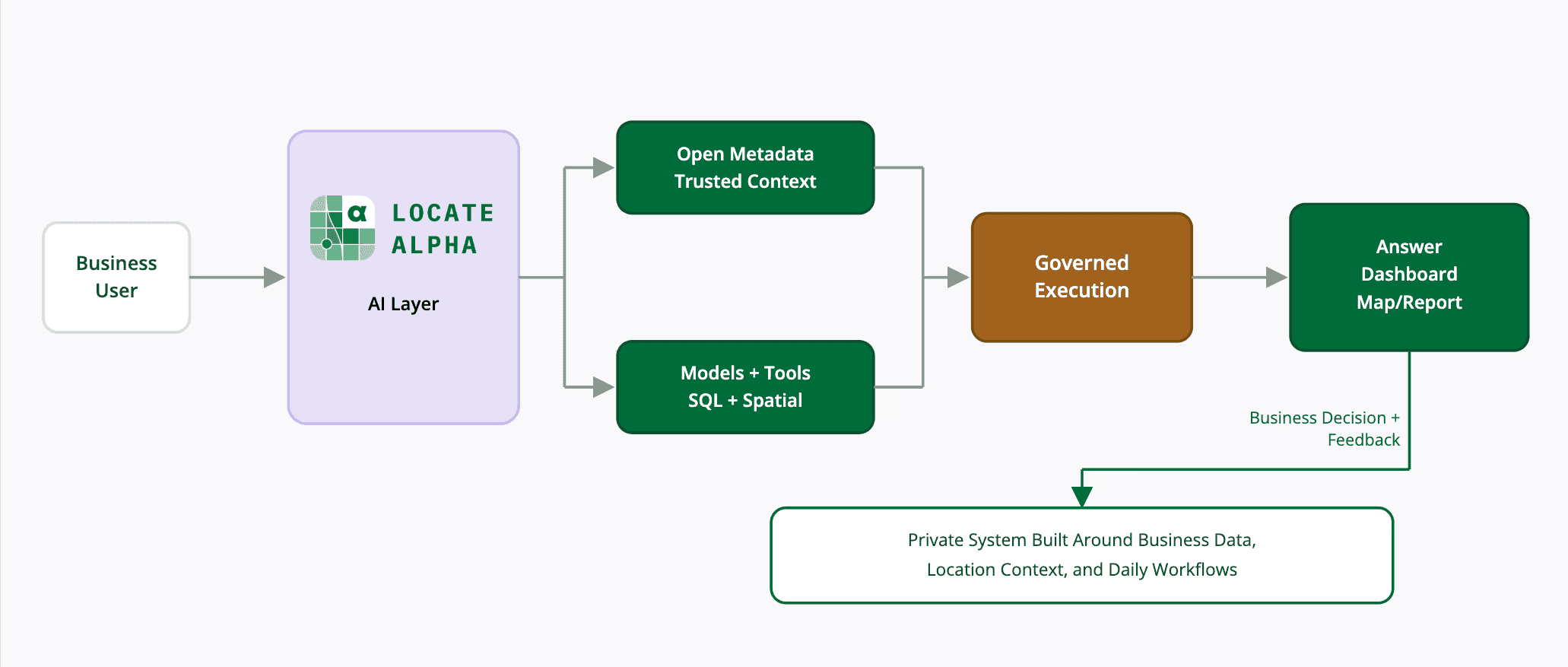
Open-source models give businesses control. A useful product still needs orchestration. The system has to decide which model should handle the task, which tool should be called, what data should be exposed, and what output format will help the user make a decision.
This is where the product becomes domain-specific. The system needs to understand leases, rent rolls, maintenance, properties, portfolios, coordinates, boundaries, proximity, territories, and map-ready results as connected parts of the same workflow.
For example, "nearby" is not a simple text match. A nearby-search workflow needs to know how distance is calculated, what location data is being used, and how the result should be returned to the user. A property workflow may need to compare assets inside a boundary, find nearby competitors, summarize a trade area, or connect lease data with location context.
This is where Locate Alpha's depth matters. We are building private systems for businesses where geography, assets, and operations are part of the core decision process.
Final thoughts
AI should not sit outside the business as a rented black box. It should become part of the company's own operating layer.
That means private AI systems that understand internal data, location context, and day-to-day workflows. Systems that can answer property questions, support portfolio decisions, run spatial analysis, generate dashboards, and keep sensitive data under the company's control.
That is what Locate Alpha helps businesses build.
If your company is trying to set up internal AI software, private model workflows, deal analysis or asset-management automation, Locate Alpha can help design, build, and deploy the system around your data and your operations.