AI
The Case for Third-Party Data in Revenue Management
While preparing for a recent RFP in revenue management, we've come to realize that alternative third-party data is becoming increasingly important to modern revenue management systems.

Why Internal Data Comes First
From an asset manager's perspective, internal data is naturally seen as the most important factor in managing a portfolio. A company with a sizable portfolio may track hundreds of thousands of listings on the market — observing clicks, visits, phone calls, and other engagement metrics to understand market trends and decide whether to adjust prices to hit revenue targets.
Some property management software (PMS) software includes a revenue optimization module that relies on this internal data. But that alone doesn't meet the needs of many build-to-rent (BTR) companies today, especially those that are also developers and need to factor in other projects in their pipeline when setting revenue targets.
The Limits of Internal Data
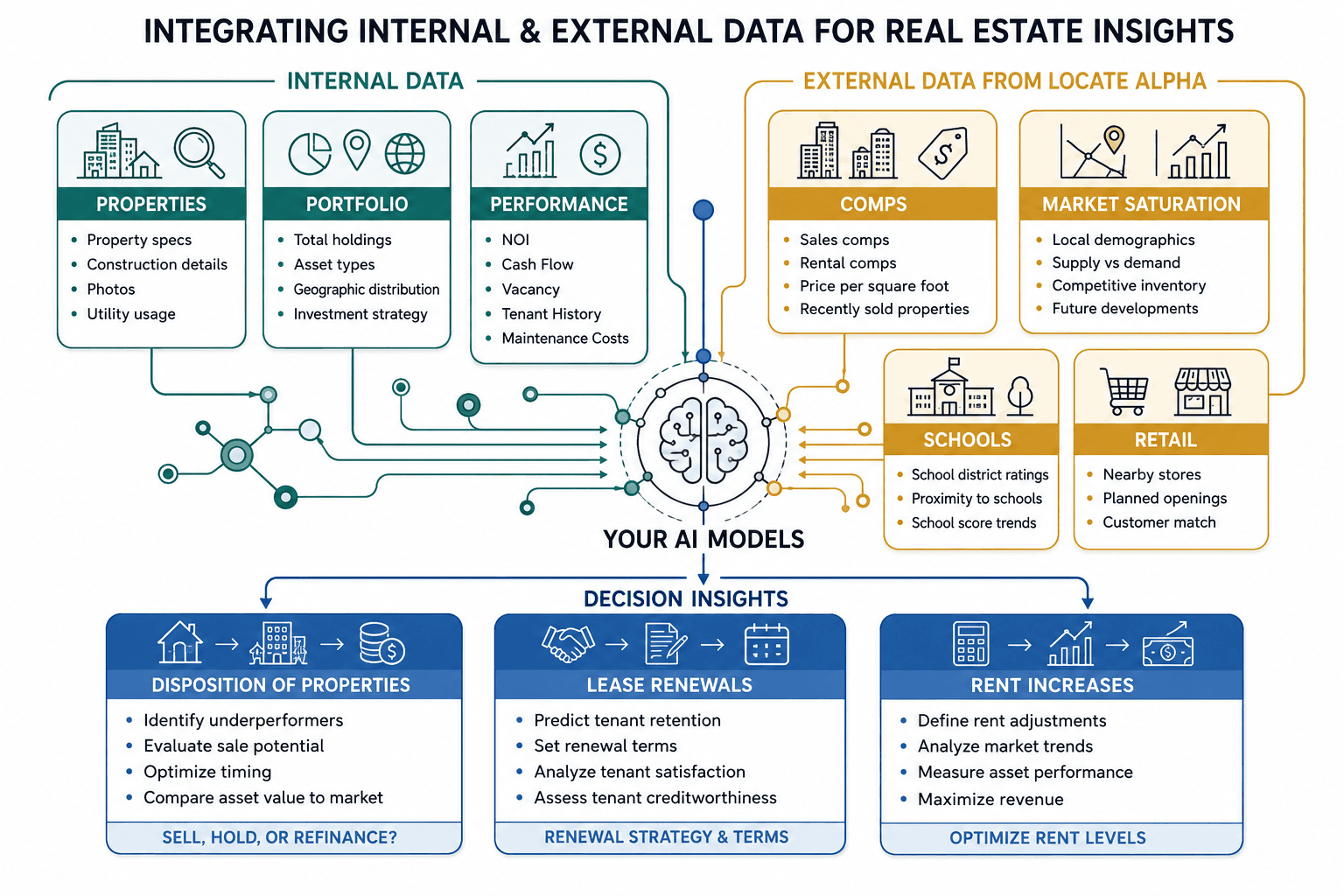
Internal data alone doesn't tell the whole story. It can't fully reflect true market conditions or how a company should be managing its portfolio.
For example, BTR operators need consistently refreshed automated valuations (AVMs), days-on-market (DOM), and months of inventory (MOI) data to track pricing power. They need to understand absorption speed of surrounding communities and how this varies by season. BTR operators also need visibility into nearby new communities in development, delivery pipelines, and available units and comps when making decisions.
The Underused Signals
Beyond that, there are less obvious but equally important data points:
School score changes and attendance zone boundary changes can inform whether you should renew a lease or dispose of a property
New road construction nearby can meaningfully shift a location's accessibility and, in turn, its value.
Psychographic data matters more than many BTR companies realize — moving inventory quickly depends on targeting the right customer base with the right campaigns.
Nearby retailers are also another underused signal. Certain retailers appeal strongly to specific customer segments — Chick-fil-A, for instance, tends to attract families with young children, a core demographic for BTR tenants. Tracking new retail openings nearby can meaningfully inform revenue strategy.
Whether the home is consistent with its surroundings - a home substantially different than the norm for that neighborhood is going to underperform in that location
The Problem with Lagging Indicators
Some might argue that market conditions eventually show up in internal metrics anyway — click volume, for instance, will reflect a shifting market over time. We don't disagree. But there's a real lag in those signals, and they only tell you what happened, not why. Without understanding the "why," it's hard to act — and by the time the internal data catches up, the window to respond has often already closed.
Sync, Not Just Access
To make this data actually useful in a revenue management system, it needs to be synced to your data warehouse, not just accessed via API. APIs are well suited for ad hoc lookups and presentation, but a proper data sync — delivering a curated, structured dataset — is what allows you to actually build and maintain models with it.
The Competitive Edge
We believe third-party and alternative data are critical to modern revenue management. Every company knows how to use its own internal data to model performance and streamline workflows — but it's the external data that gives you a real edge over the competition.