Land
Homebuilder
AI
How Locate Alpha Is Helping Homebuilders Unlock SB-9 Opportunities Across California
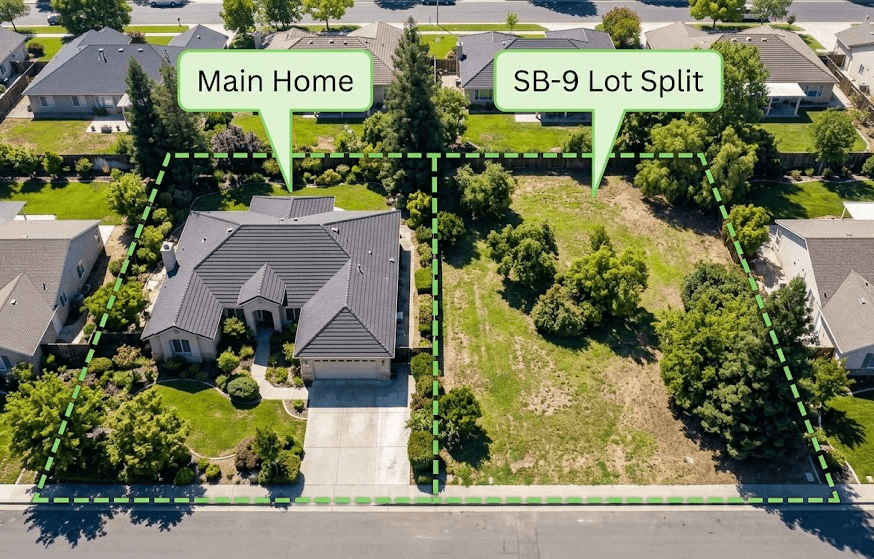
California's SB-9 legislation opened the door for qualifying single-family lots to be split into two parcels, each eligible for new residential development. For home builders and investors, this represents a massive expansion of the buildable land supply — but only if you can identify which parcels actually qualify. That's where Locate Alpha comes in.
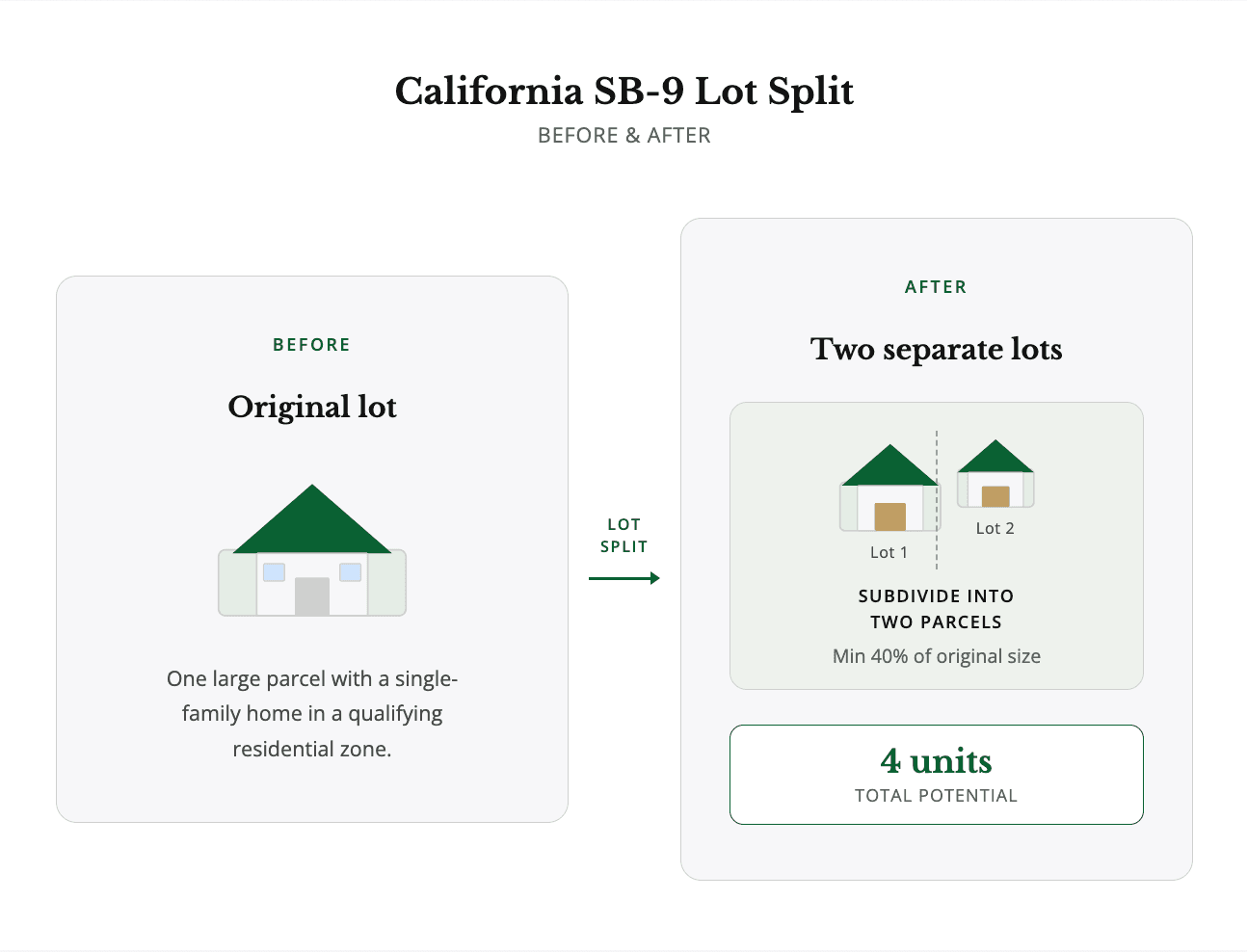
We've been working closely with innovative builders like Veev, a vertically integrated prefab home builder, to develop a powerful SB-9 analysis engine that evaluates every parcel in California for lot-split eligibility. Here's what we've built and why it matters.
The SB-9 Challenge: Finding Needles in a Haystack
SB-9 allows homeowners and developers to split a qualifying single-family residential parcel into two independent lots, each capable of supporting new construction. The core requirement is straightforward in principle: after the split, the remaining parcel cannot be less than 40% of the original lot area. But applying that rule across millions of California parcels — while also accounting for building footprints, setbacks, lot width, and local zoning — is anything but simple.
Builders working on infill projects face a compounding set of constraints. It's not enough to find a parcel that meets the 40% area threshold. The resulting lots also need to be wide enough to accommodate a home's footprint, have adequate frontage for driveway access, comply with floor-area-ratio (FAR) requirements by jurisdiction, and fit within the setback lines mandated by local code. Manually screening parcels against all of these criteria is slow, error-prone, and doesn't scale.
What We Built: Statewide SB-9 Eligibility at the Parcel Level
Locate Alpha's SB-9 analysis engine runs a comprehensive eligibility assessment against every residential parcel in the state of California. The system evaluates each parcel's geometry to determine whether a compliant lot split is feasible, flagging those that meet the 40/60 split rule — ensuring neither resulting parcel falls below 40% of the original lot.
From Analysis to Acquisition: The Full Workflow
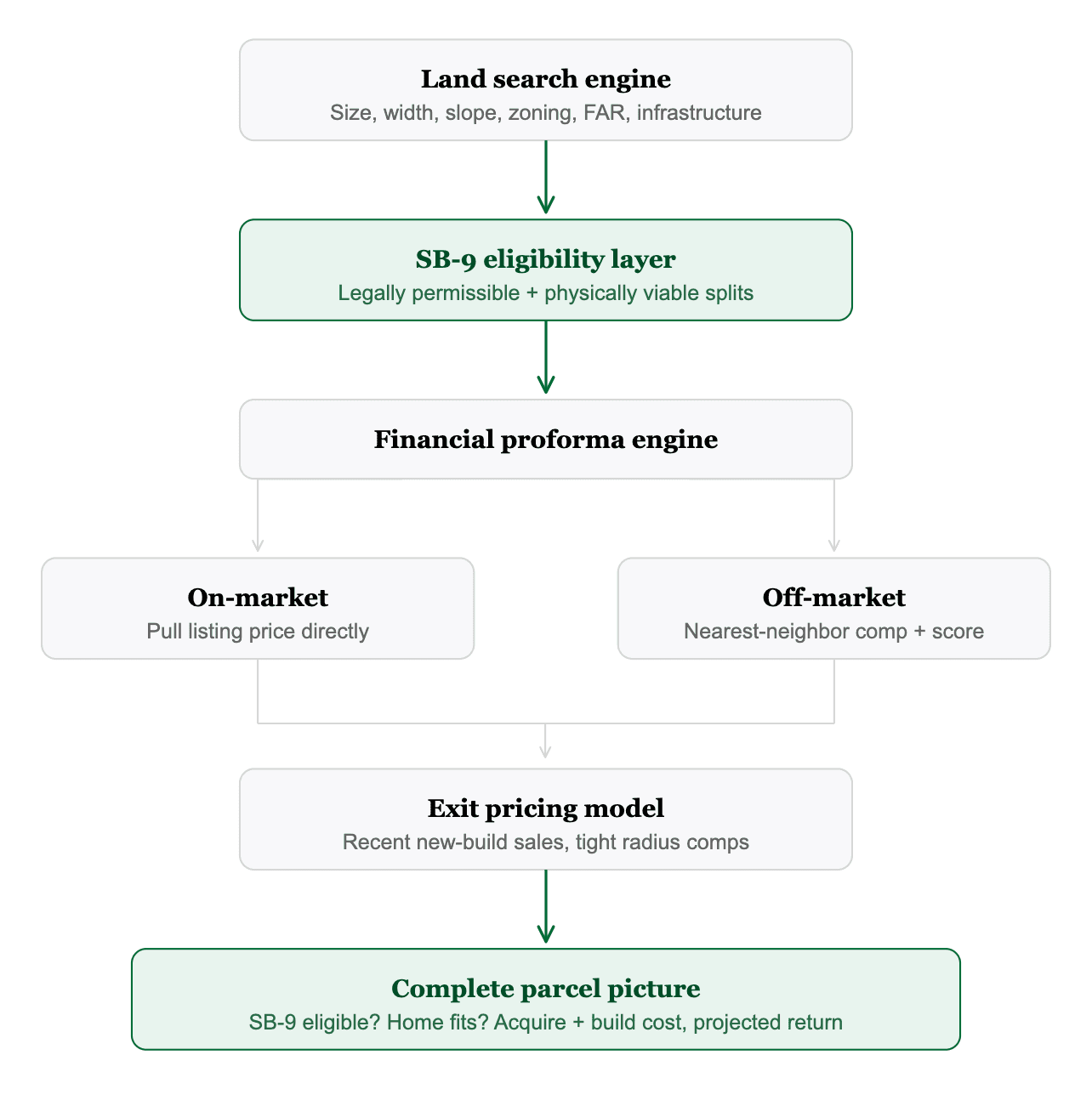
What sets this approach apart is that SB-9 analysis doesn't exist in isolation. It's one layer in a broader land intelligence workflow that takes a builder from opportunity identification all the way through to financial underwriting.
The workflow starts with our core land search engine, which filters parcels by size, width, slope, zoning, building coverage, proximity to infrastructure, and dozens of other criteria. Layering SB-9 eligibility on top of that immediately narrows the field to parcels where a lot split is both legally permissible and physically viable.
The result is a complete picture for each parcel: Does it qualify for SB-9? Does the builder's home model physically fit? What would it cost to acquire the land, build the home, and what is the projected return on a sale?
Why This Matters for the California Housing Market
California's housing shortage is well documented, and infill development is a critical part of the solution. SB-9 was designed to unlock density on existing residential lots, but adoption has been slower than legislators hoped — in large part because the opportunity identification process has been manual and fragmented.
By automating SB-9 eligibility analysis at scale and combining it with live market data and financial modeling, we're helping builders move faster and with more confidence. A builder that previously spent weeks cross-referencing sales data, parcel maps, and zoning codes can now surface qualified opportunities in seconds.
For builders, this means more efficiently connecting investors and homeowners with buildable land that fits their prefabricated home models — homes that can go from building permit to move-in ready in four months, at roughly half the cost of typical infill construction. For the broader market, it means more homes getting built on land that's already there, waiting to be put to better use.
What's Next
We're continuing to deepen the SB-9 analysis with additional jurisdiction-specific rules, ADU feasibility modeling, and enhanced spatial algorithms. The goal is a system where a builder can define their product, set their financial criteria, and instantly see every viable opportunity in their target market — whether that's a lot split, a teardown, or a vacant infill parcel.
If you're a builder, developer, or investor working on infill or SB-9 projects in California, we'd love to show you what's possible.